
What Are You Looking For?
In transformer protection systems, surge arresters intercept lightning strikes and switching overvoltages, while fuses are responsible for cutting fault currents. In practice, both devices can simultaneously experience energy surges from the line. Improper coordination may result in the fuse tripping prematurely before the arrester has a chance to operate. IEEE C37.48.1 Section 7.5 provides guidance for achieving seamless coordination between these two critical devices.
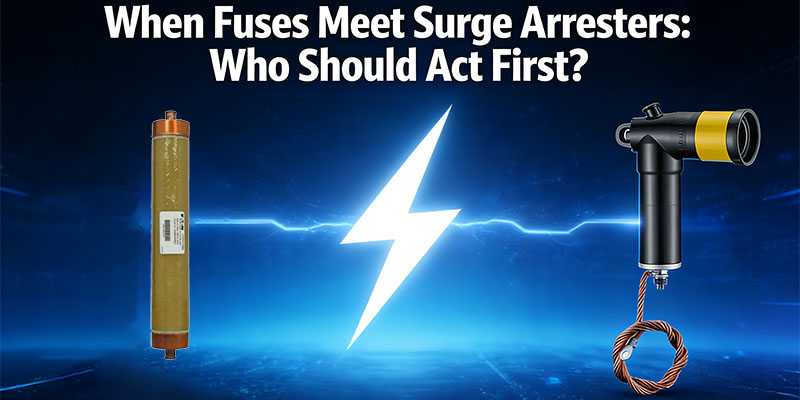
A surge arrester acts like a pressure release valve: when voltage exceeds its threshold, it transitions from high resistance to low resistance, diverting massive lightning currents safely to ground.
Fuses, on the other hand, are thermally sensitive, responding to the I²t energy of the current passing through.
Ideal scenario: During a lightning strike, the arrester should conduct almost all of the surge current to ground, leaving the fuse intact. This ensures that once the surge passes, the system can resume normal operation immediately.
The installation location of the arrester is pivotal to protection logic.
Upstream (source side) of the fuse: The lightning current bypasses the fuse entirely. This is the preferred configuration, eliminating the risk of fuse misoperation.
Downstream (load side) of the fuse: Common in pad-mounted transformers, the lightning current must flow through the fuse to reach the arrester. In this setup, surge withstand capability must be verified to prevent unnecessary fuse operations.
When the arrester is downstream, IEEE C37.48.1 Section 7.5.2 specifies that the fuse’s minimum melting I²t must exceed the I²t generated by the arrester during lightning discharge.
Lightning waveform: Typical 8/20 μs impulses reach thousands of amperes, but for an extremely short duration.
Coordination principle: For current-limiting fuses (CLFs), their fine wire is highly sensitive to thermal stress. Engineers must verify surge withstand capacity. A fuse that is too small may trip instantly, even if the arrester successfully limits the voltage, causing unnecessary outages.
A more advanced concern arises with arc voltage generation during fuse operation.
Potential risk: If the fuse’s arc voltage exceeds the arrester’s discharge voltage, the arrester may fire while the fuse is still clearing the fault.
Consequence: The arrester could be forced to absorb excessive energy, exceeding its design limit and potentially leading to physical damage or explosion. IEEE standards recommend considering the arrester’s protection level when selecting the fuse voltage rating to prevent such conflicts.
To achieve optimal fuse-arrester cooperation, follow these three golden rules:
Preferred positioning: Install the surge arrester upstream (toward the source) of the fuse whenever possible.
Energy verification: If the arrester is downstream, ensure the fuse can safely withstand standard lightning currents (e.g., 65 kA peak) without damage.
Voltage coordination: The arrester’s rated voltage and protection level (VCL) must exceed the system’s maximum operating voltage but remain below the BIL rating of the transformer and fuse mounting.
Professional conclusion: Think of the arrester as a shield and the fuse as a gate. A well-designed system lets the shield block external lightning while the gate closes only for internal faults, ensuring both safety and reliability.