
What Are You Looking For?
Protecting motors in a power distribution system is far more intricate than protecting transformers. Motors generate massive inrush currents during startup—typically 6–8 times their rated current—and this surge repeats thousands of times over the motor’s life. Standard “E” rated fuses are often inadequate for this repetitive stress. To address this, IEEE C37.48.1 introduces the “R” rating and the critical K-factor specifically for motor protection.
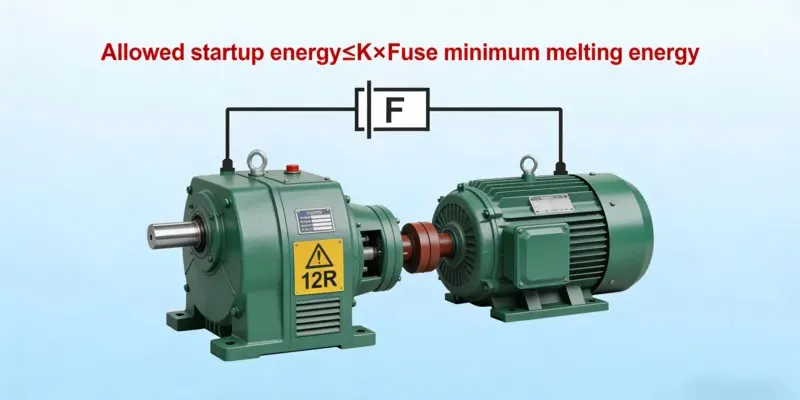
Unlike transformer-focused E-rated fuses, the R rating is tailored for motor starters and acts as a backup current-limiting fuse.
Definition: The R rating specifies the fuse’s melting characteristics at a given current. For instance, a 12R fuse must melt between 15–35 seconds at 2320A.
Design intent: R-rated fuses are not meant for overload protection—that role is handled by thermal overload relays. Instead, their purpose is short-circuit protection, designed to withstand prolonged startup currents without fatigue. Their melting curves are deliberately robust, ensuring reliability under repeated motor startups.
Section 6.1.7.3 of IEEE C37.48.1 introduces the K-factor, a crucial parameter to evaluate a fuse’s endurance under repetitive motor starting surges.
Physical meaning: Each motor startup heats and expands the fuse element; cooling contracts it. This repeated thermal cycling induces micro-cracks in the fuse material.
Role of K-factor: It acts as a derating coefficient, typically 0.6–0.7, limiting the allowable I²t energy of each startup relative to the fuse’s minimum melting I²t.
Formula:
Allowed startup energy≤K×Fuse minimum melting energy
Exceeding this ratio may not cause immediate failure, but it weakens the internal structure, increasing the risk of nuisance tripping during future startups.
Using generic high-current fuses for motor protection poses two major risks:
Protection blind spots: Oversized fuses may avoid tripping during startup, but fail to respond quickly to medium-level faults, leaving contactors and motor windings exposed.
Low impact tolerance: Standard fuse alloys are not optimized for repetitive thermal cycling. Their K-factor is often far lower than that of R-rated fuses, leading to early fatigue and potential failure.
IEEE C37.48.1 Section 6.1.7 recommends the following methodology for motor fuse selection:
Curve alignment: Ensure the minimum melting current curve of the fuse lies to the right of the motor’s inrush current curve.
K-factor verification: Calculate the total energy of repeated startups and confirm it remains within the fuse’s fatigue threshold.
Interrupting rating check: Confirm the fuse’s maximum interrupting current exceeds the system’s maximum possible short-circuit current.
Motor protection is a delicate balance of endurance and response speed.
R rating provides the fuse with the endurance to withstand repeated startup surges.
K-factor gives engineers a quantitative measure to ensure the fuse is not overstressed.
Professional advice: When replacing a high-voltage motor fuse, do not choose based solely on amperage. Always check the nameplate for the R marking and verify the K-factor relative to the motor’s expected startup frequency. Proper consideration ensures both safety and longevity of motor protection.