
What Are You Looking For?
In distribution engineering, the 34.5 kV system occupies a special niche. It combines the advantages of high-voltage long-distance transmission with unique equipment selection challenges. For single-phase transformers, many engineers stumble over terms like “34.5 kV,” “19.92 kV,” and “35 kV Class.” Choosing the wrong voltage rating can lead to nuisance fuse operations at best, or catastrophic insulation failure at worst. Using IEEE C37.48.1 as a guide, we can demystify these selection rules.
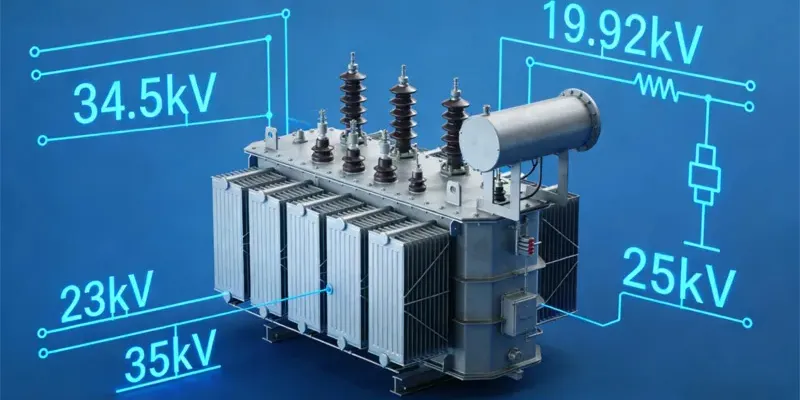
In a typical 34.5 kV grounded Y (GrdY) system, two key voltages define transformer design:
Line-to-Line Voltage (Phase-to-Phase): 34.5 kV. This represents the system’s overall insulation requirement.
Phase-to-Ground Voltage: 34.5 kV÷3=19.92 kV34.5 \text{ kV} \div \sqrt{3} = 19.92 \text{ kV}. This is the voltage actually applied to the transformer’s high-voltage winding.
Understanding this distinction is crucial: fuses and internal windings are exposed to phase-to-ground voltage, whereas external insulation must handle line-to-line stress.
IEEE C37.48.1 Section 6.1.8 clarifies fuse voltage selection based on maximum recovery voltage across the fuse during fault clearing.
For single-phase transformers connected phase-to-ground: Even in short-circuit conditions, the highest voltage the fuse must interrupt equals the phase voltage, 19.92 kV.
Fuse selection guideline: Pick a rating slightly above this voltage. Industrial practice favors 23 kV or 27 kV fuses.
Pitfall to avoid: Installing a 35 kV current-limiting fuse can generate excessive arc voltage during interruption, potentially exceeding the transformer winding’s insulation BIL, causing internal damage (IEEE C37.48.1, Section 6.1.3.5).
Interestingly, while the internal fuse is rated 23 kV, the transformer’s external bushing is typically specified as 35 kV Class.
External insulation rationale: Bushings are exposed to air and must withstand line-to-line flashover, creepage, and lightning impulses.
Compliance: IEEE Std 386 and related standards dictate that external insulation follows the highest system voltage, ensuring safe operation under all stress conditions.
IEEE C37.48.1 Section 6.1.8 also warns:
In ungrounded or high-resistance grounded delta systems, a single-phase ground fault causes the other two phases’ voltage to rise to line voltage (34.5 kV).
Using a 23 kV fuse in this scenario is dangerous—the fuse may face voltages far beyond its rating, risking explosion or sustained arcing.
Solution: Fuses must be rated above the system line voltage (>34.5 kV).
For single-phase transformers in 34.5 kV GrdY systems, keep these selection rules in mind:
| Component | Recommended Voltage | Rationale |
|---|---|---|
| Transformer winding | 19.92 kV | Matches phase-to-ground voltage |
| Internal ELSP fuse | 23 kV | Controls arc voltage, prevents nuisance operation |
| External bushing | 35 kV Class | Matches line-to-line voltage, ensures safe air insulation |
Professional reminder: Never confuse system insulation level with equipment recovery voltage. Correct voltage matching not only ensures energization but also protects your transformer from destructive overvoltages during faults.