
What Are You Looking For?
In modern distribution networks, pad-mounted transformers are often installed in residential areas or commercial spaces, sometimes just inches from pedestrian paths. Ensuring public safety and transformer longevity requires a fail-safe protection strategy. The industry-standard solution is the series combination of Bay-O-Net expulsion fuses and ELSP backup current-limiting fuses.
Why is this “one inside, one outside, one passive, one active” setup called the golden pair? A deep dive through the lens of IEEE C37.48.1 reveals the reasoning.
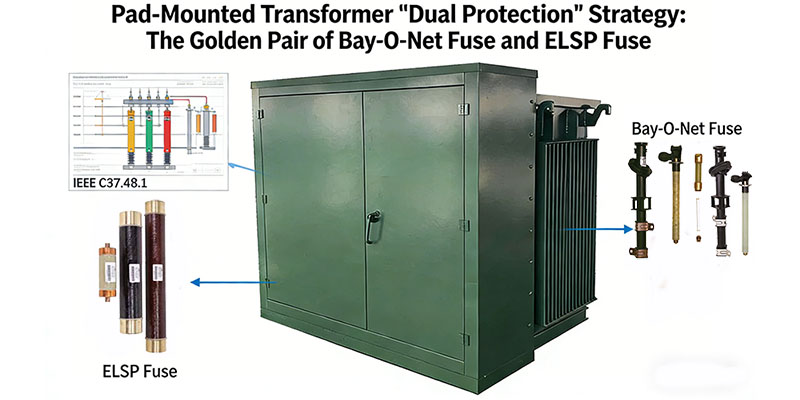
According to IEEE C37.48.1 Section 4, the physical operating mechanisms of these two fuses define their responsibilities:
Bay-O-Net Fuse (First Line of Defense):
This expulsion fuse mounts externally on the transformer tank. It is highly sensitive to low-current faults, handling secondary-side short circuits and prolonged thermal overloads. Its main advantage is external replaceability using a hotstick, keeping operators safely away from energized components.
ELSP Fuse(Final Line of Defense):
This is a backup current-limiting fuse installed inside the transformer tank. Normally dormant, it only operates during high-energy internal faults, such as winding-to-ground failures. Its current-limiting capability reduces the fault energy drastically, preventing internal pressure spikes that could rupture the tank.
Per IEEE C37.48.1 Section 7.3, the coordination between Bay-O-Net and ELSP requires precise time-current characteristic (TCC) curve alignment:
Low-Current Region: The Bay-O-Net curve sits on the left. For small overloads or minor faults, it acts first, safeguarding the more costly and difficult-to-replace ELSP.
High-Current Region: As fault current rises, the curves intersect. In extreme short-circuit scenarios, the ELSP reacts faster than Bay-O-Net.
Matched Melting: This ensures high-energy faults are interrupted by the current-limiting fuse with superior arc-extinguishing capability, while preventing the expulsion fuse from attempting to interrupt currents beyond its design capacity.
Only Bay-O-Net Fuse: Its interrupting capacity is limited. Severe internal faults may sustain arcs in the oil, potentially rupturing the tank.
Only ELSP Fuse: Being a backup fuse, ELSP handles low-current overloads poorly. It may melt but fail to extinguish arcs, causing destructive internal sparking.
The synergy of Bay-O-Net outside, ELSP inside ensures both low-current protection and catastrophic-fault mitigation.
IEEE C37.48.1 Section 6.1.9 provides clear guidance:
Bay-O-Net Fused: Typically indicates an external overload or secondary-side issue. After resolving the root cause, replacing the fuse restores normal operation.
ELSP Fused: Indicates a catastrophic internal fault. Replacing only the external Bay-O-Net fuse and attempting to re-energize is extremely dangerous and may trigger secondary catastrophic failure.
The dual protection strategy embodies redundancy and complementarity:
Bay-O-Net Fuse provides operational flexibility and low-current fault protection.
ELSP Fuse offers ultimate protection against internal catastrophic faults.
For distribution engineers, carefully following the TCC coordination tables in IEEE C37.48.1 is the cornerstone of safe pad-mounted transformer operation in urban environments.