
What Are You Looking For?
In power distribution design, assuming that any current-limiting fuse can simply be installed on a transformer as long as voltage and current ratings match is a critical mistake. According to IEEE C37.48.1, Section 5, current-limiting fuses are categorized into three major types based on their minimum interrupting capability. Choosing the wrong type can lead to catastrophic failures: instead of safely extinguishing the arc, the fuse may “explode” under low-current faults.
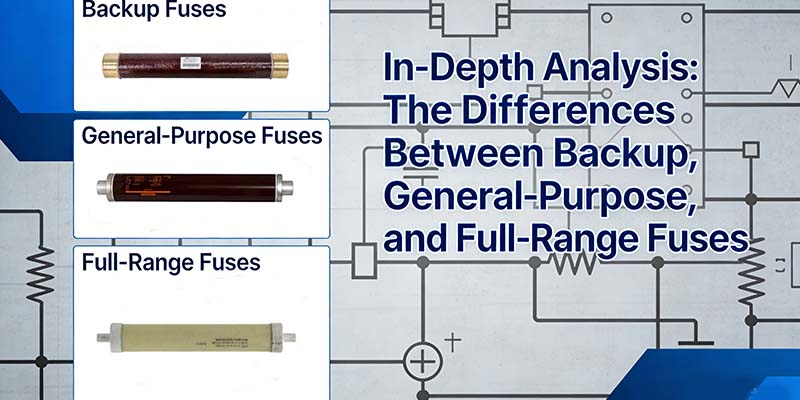
Backup fuses, such as ELSP units, are the most commonly used type in pad-mounted transformers.
Definition: Backup fuses are designed to interrupt faults that fall between their rated minimum interrupting current and their maximum rated interrupting current.
Limitation: These fuses excel only at handling high-current events, such as internal transformer short circuits. If a lower current flows through—such as during light, long-term overloading—the fuse may overheat or even melt without properly extinguishing the arc.
Must Be Paired: IEEE C37.48.1 Section 5.1 stipulates that backup fuses must be used in series with devices capable of handling low-current faults, such as Bay-O-Net expulsion fuses. This ensures small faults are safely interrupted.
Definition: General-purpose fuses are rated to interrupt all currents that will melt the fuse within one hour.
Application: These fuses offer a broader protection range than backup fuses. However, at extremely low overcurrent conditions, they may still have “blind spots.” They are typically used in indoor distribution panels or motor control centers (MCCs).
Definition: Full-range fuses can interrupt any current from the minimum melt current—enough to vaporize the fuse element—to the maximum rated interrupting current.
Advantages: They can be used independently without the need for additional series fuses.
Trade-Off: These fuses are physically larger and more expensive. They incorporate advanced arc-extinguishing components to manage energy across the full spectrum of fault currents.
In a 19.92 kV system, if you are using an ELSP fuse, remember:
It is a backup fuse.
Low-voltage side faults may produce currents below its minimum interrupting rating.
Without a series Bay-O-Net, the ELSP fuse cannot extinguish the low-current arc, potentially overheating, damaging supports, or increasing transformer oil pressure.
Correct pairing ensures that both small and large fault currents are safely interrupted.
IEEE C37.48.1 Section 5.3 emphasizes precise interpretation of fuse ratings. For instance:
Fuses with “E” ratings (power-grade) and “C” ratings (distribution-grade) have strict time-current characteristics.
In pad-mounted transformer applications, fuse class must match the protection logic—whether series protection or standalone—to prevent catastrophic failure.
Professional Advice: Always check the Minimum Interrupting Rating in the specification sheet. If it is not zero or close to the rated load current, the fuse is a backup type and requires a small-current partner to ensure comprehensive protection.