
Surge Arresters for Transformer Protection: A Selection Checklist
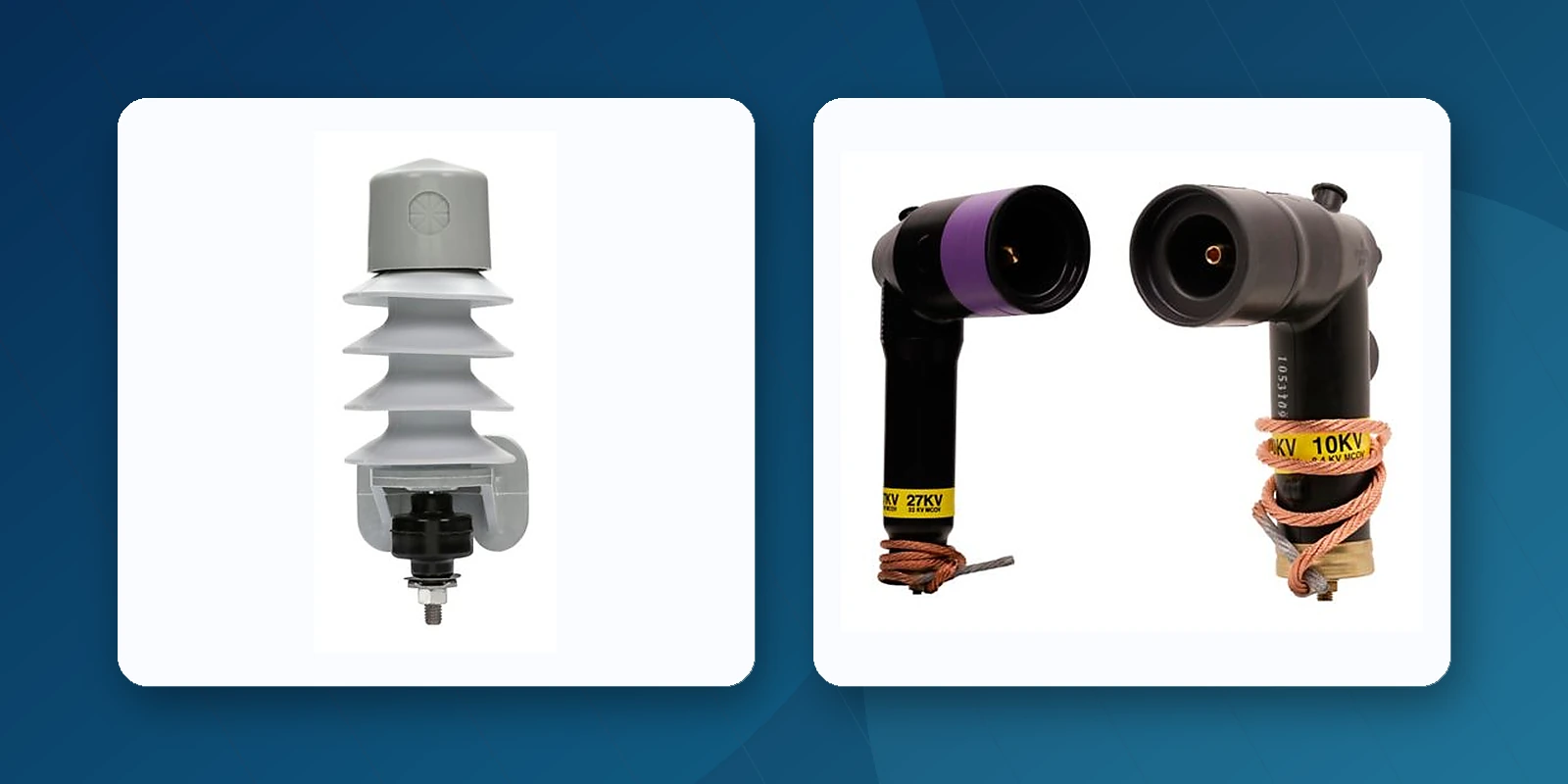
1. Why Surge Protection is Non-Negotiable
Transformers represent one of the largest capital investments in any distribution system. A single lightning strike — even one miles away on the distribution line — can induce voltage surges that exceed the transformer's Basic Impulse Level (BIL) by orders of magnitude. Without effective surge protection, the result is catastrophic insulation failure: punctured windings, shorted turns, and complete transformer loss.
Surge arresters function by providing a nonlinear path to ground. Under normal system voltage, they present near-infinite impedance. When a surge voltage exceeds their protective level, their resistance drops dramatically, diverting surge energy to ground while clamping the voltage at the transformer terminals to a safe level. Once the surge passes, they instantly return to high-impedance state — ready for the next event.
2. Eaton Cooper MOV Distribution Arresters
Eaton's Cooper Power series distribution-class surge arresters utilize Metal Oxide Varistor (MOV) technology, which offers superior protection characteristics compared to older silicon carbide designs:
- Superior nonlinearity — MOV elements provide flatter voltage-current characteristics, meaning better protection margins between arrester rating and system voltage
- No series gaps — Gapless design eliminates sparkover uncertainty and ensures consistent protection regardless of surge waveshape
- High energy handling — MOV blocks absorb significantly more energy per unit volume than SiC, enabling compact designs with higher thermal capacity
- Excellent temporary overvoltage (TOV) capability — Withstands sustained overvoltages from ground faults and load rejection without thermal runaway
- UltraSIL polymer housing option — Eaton's proprietary silicone rubber housing provides superior hydrophobicity, tracking resistance, and weatherability compared to porcelain
Key Distribution Arrester Models:
- 3238018C15M — 15kV distribution-class MOV arrester. Standard model for 12.47kV and 13.8kV distribution systems. Metal oxide varistor technology with polymer housing. Featuring Eaton's UltraSIL advantage for long-term outdoor performance. Compatible with standard distribution arrester mounting brackets.
- 3238018C17MC — 15/17kV distribution-class MOV arrester. Higher MCOV (Maximum Continuous Operating Voltage) rating for systems with elevated nominal voltage or known overvoltage conditions. Suitable for 13.2kV and 13.8kV systems where voltage regulation may be less precise.
Additional Arrester Options:
- 15kv arrest (generic Cooper model designation) — 15kV class distribution arrester series covering multiple MCOV ratings to match specific system voltages.
- Distribution-class, intermediate-class, and station-class arresters — Three tiers of protection for applications ranging from distribution transformers to substation transformers and critical equipment. Higher classes offer greater energy handling and lower protective levels.
3. Elbow Arresters for Dead-Front Applications
For pad-mounted transformers with dead-front construction, conventional externally mounted arresters are not practical. Eaton Cooper's elbow arrester solution integrates MOV protection directly into a 200A loadbreak elbow form factor:
- Elbow arrester — Plugs directly into a 200A loadbreak bushing insert, providing surge protection at the transformer bushing — the ideal location electrically. Available with voltage ratings matching standard distribution voltages. The integrated design eliminates external arrester mounting brackets and the associated lead length inductance that degrades protection performance.
Elbow arresters are particularly valuable for:
- Pad-mounted transformers in underground residential distribution (URD) systems
- Dead-front switchgear where external arrester mounting space is limited
- Retrofit applications where adding external arresters would require tank modifications
- Installations where minimizing the visual profile of transformer equipment is desired
4. Cross-Reference and Replacement Guide
Eaton Cooper elbow arresters are designed to cross-reference with competitive products, simplifying replacement and retrofit projects. The Elbow Arrester Cross Reference Tables provide direct model-to-model mapping between Eaton Cooper arresters and products from other major manufacturers including Hitachi-ABB and Siemens.
When replacing existing arresters, key parameters to match include:
- MCOV (Maximum Continuous Operating Voltage) — must exceed the highest sustained line-to-ground voltage
- TOV capability — must withstand expected temporary overvoltage duration
- Energy handling class — must meet or exceed the original specification
- Physical interface — ensure compatibility with existing bushing inserts and mounting configurations
5. Selection Criteria: Matching Arresters to Your Application
- System voltage and grounding — Solidly grounded, impedance grounded, and ungrounded systems require different arrester ratings. The MCOV must exceed the maximum line-to-ground voltage under worst-case conditions (typically single line-to-ground fault on an ungrounded system).
- Protective margin — The arrester's protective level (discharge voltage at the coordinated surge current) must provide adequate margin below the transformer's BIL. Industry standards recommend a minimum 20% margin.
- Energy handling — For substation transformers or locations with high lightning exposure, select arresters with higher energy discharge capability (kJ/kV rating).
- Mounting location — For pad-mounted transformers, elbow arresters at the bushing provide optimal protection. For substation transformers, station-class arresters at the high-voltage terminals are standard.
- Environmental conditions — Coastal, industrial, and high-pollution environments benefit from polymer-housed arresters (UltraSIL) with superior contamination performance.
6. Integrated Protection: Arresters in the Complete System
Surge arresters should never be selected in isolation. Their coordination with other protective devices — fuses, breakers, and reclosers — is essential for system reliability:
- Arrester operation should never cause upstream protective device operation (nuisance tripping)
- For under-oil MOV arresters in pad-mounted transformers, verify compatibility with the transformer fluid (mineral oil, FR3, or R-Temp)
- In two-fuse protection schemes (Bay-O-Net + ELSP), ensure the arrester's energy let-through during surge events does not compromise fuse coordination
Manufacturer Resources
Use the latest manufacturer literature for final ratings, ordering codes, installation, and safety requirements.
Frequently Asked Questions
What is the most important rating when selecting a surge arrester?
MCOV is a critical starting point because it must exceed the maximum continuous line-to-ground voltage at the installation. The complete selection also considers duty-cycle rating, temporary overvoltage, protective level, and energy duty.
When is an elbow arrester useful?
A shielded elbow arrester is useful in deadfront pad-mounted equipment, vaults, and cable systems where it can connect directly to a compatible separable interface.
Where should arresters be installed for transformer protection?
They are generally most effective when connected close to the equipment being protected with a short, direct grounding path. Final placement must follow the system design and manufacturer instructions.
Looking for Surge Arresters?
Jiuyingtech supports inquiries for Eaton Cooper distribution arresters, including 3238018C15M and 3238018C17MC, as well as elbow and other arrester classes. Availability and cross-reference suitability are confirmed for the specific application.